

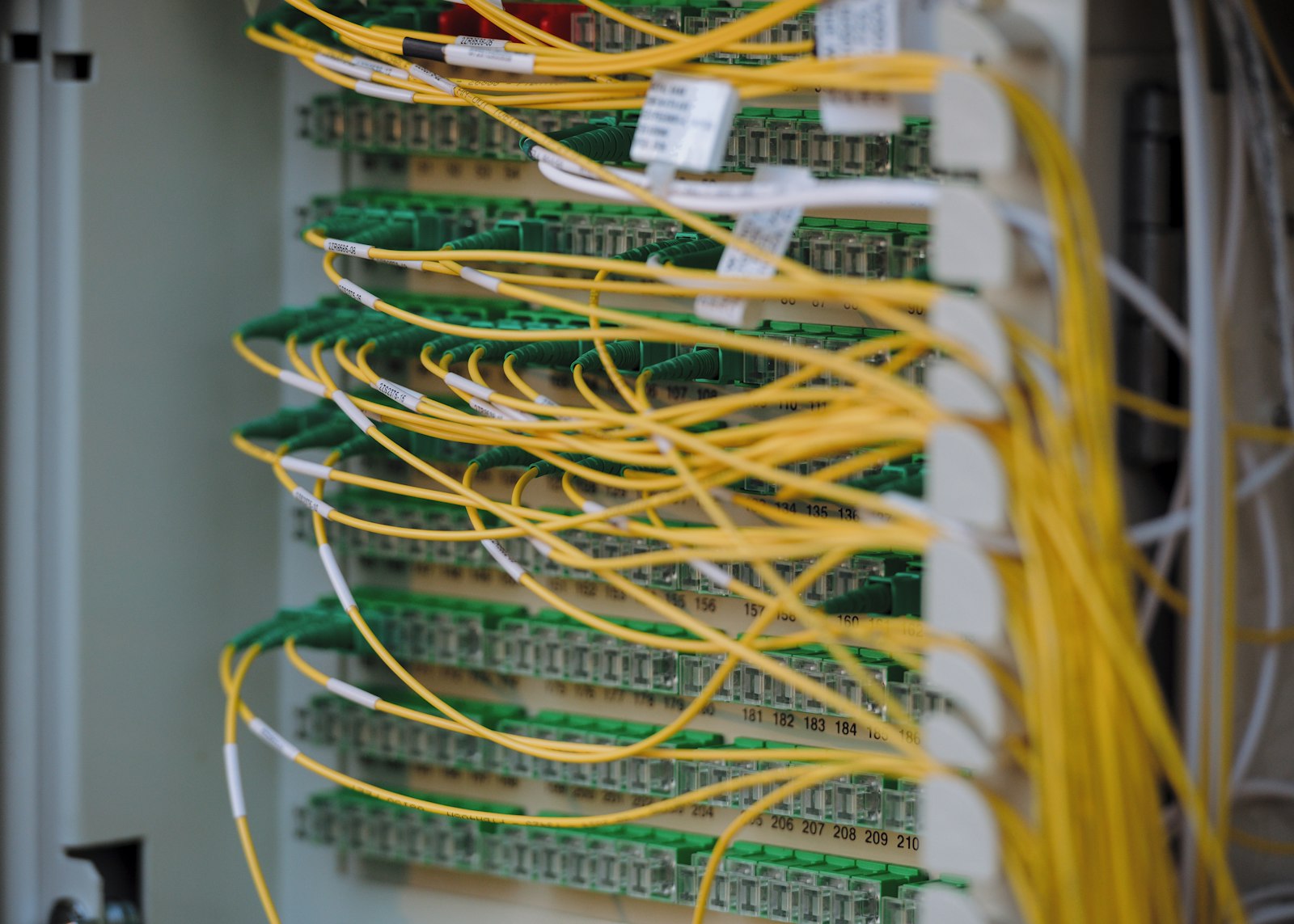
A quantum internet would not replace the internet carrying this page to your screen. It would run alongside it, as a separate network built to move quantum information, states of matter that carry a kind of fragility and sensitivity ordinary data never has, between quantum computers and quantum sensors rather than between regular web servers. That distinction matters, because most of the excitement and most of the confusion around the idea comes from assuming it is simply a faster or more secure version of what already exists.
What a Quantum Internet Would Move
Today’s internet moves bits, straightforward 0s and 1s, copied and relayed at every step along the way. A quantum internet would move qubits, and qubits cannot be copied the way bits can; measuring or duplicating a quantum state tends to disturb or destroy it. That property is a limitation for ordinary data transmission, but it is also the entire reason researchers want the network in the first place: it is what would let two distant quantum computers share entangled qubits, a connection where measuring one instantly correlates with the other, or let a quantum key distribution link detect an eavesdropper by the errors they introduce just by observing the signal.
Why Governments and Labs Are Building Toward One
The U.S. Department of Energy laid out its own case for why this is worth pursuing in a 2020 announcement framing the effort as a blueprint for a national quantum network. Per DOE’s own article, the goal is a network scientists could use to build “virtually unhackable” communications, alongside faster coordinated data exchange between distant quantum computers and distributed quantum sensors capable of things like earthquake monitoring. DOE named its 17 National Laboratories as the intended backbone of that effort, with early testbeds planned between Argonne National Laboratory and the University of Chicago, and between Brookhaven National Laboratory and Stony Brook University. At the time, DOE described a prototype as something scientists believed was within reach over the following decade, a 2020 projection worth treating as a planning target rather than a current status update, since testbed progress since then has not been tracked here.
Entanglement Is the Hard Part, Not the Headline
News coverage of quantum entanglement tends to lean on the strangeness of the phenomenon, but the practical engineering problem is less about the physics being weird and more about qubits being fragile. A quantum state traveling through fiber optic cable degrades with distance far faster than an ordinary light signal does, since the very property that makes it useful, its quantum nature, also makes it sensitive to disturbance from the cable itself. Classical networks solve distance with repeaters that copy and boost the signal; a quantum network cannot use that same trick, because copying a qubit is exactly what its physics forbids. Instead, researchers are developing quantum repeaters that extend entanglement across longer distances without ever directly copying the underlying quantum state, which remains one of the central unsolved engineering problems standing between today’s short lab-scale demonstrations and a usable long-distance network.
What It Would Be Used For
A working quantum internet is not aimed at everyday browsing, streaming, or email, which classical networks already handle well. Its likely early use cases are narrower and more specialized: linking quantum computers together so multiple machines can work on a single problem as if they were one larger system, distributing quantum sensors across a wide area for more precise measurement of things like gravitational fields or seismic activity, and supporting the kind of eavesdropper-detecting key distribution that conventional networks cannot offer. None of those are everyday consumer applications, at least based on where the technology stands today, which is part of why a quantum internet is best understood as specialized infrastructure for quantum-era science and security rather than a replacement for the network you are reading this on.
How This Connects to the Rest of Quantum Computing
A quantum internet depends on, and would make more useful, a lot of the other quantum technology already in development. Our plain-language guide to quantum computing covers the basics of qubits and superposition this all builds on, and quantum error correction is just as relevant to a network as it is to a single quantum computer, since a qubit traveling across a long-distance link needs the same kind of protection against noise and decoherence that one sitting inside a processor does.
FAQs
Is a quantum internet meant to replace the regular internet?
No. It is designed as a separate, specialized network for moving quantum information between quantum computers and sensors, running alongside the classical internet rather than replacing the network that handles ordinary web traffic, streaming, and email.
Why can’t a quantum signal just be boosted like a regular internet signal?
Classical networks extend range with repeaters that copy and amplify a signal. Quantum information cannot be copied without disturbing or destroying it, so researchers are instead developing quantum repeaters that extend entanglement across distance without directly copying the underlying quantum state.
When will a quantum internet exist?
There’s no confirmed current timeline here. The Department of Energy’s 2020 blueprint described a prototype as something scientists believed was within reach over the following decade, but that was a planning projection made at the time, not a status update on where testbeds stand today.
What would a quantum internet be used for?
Likely early uses include linking distant quantum computers so they can work together on a single problem, distributing quantum sensors across a wide area for more precise measurement, and supporting eavesdropper-detecting quantum key distribution, rather than everyday consumer browsing or streaming.
Does a quantum internet require quantum computers to already exist everywhere?
Not everywhere, but it does assume quantum computers and sensors exist at the specific locations the network connects. Early testbeds have focused on linking a small number of national laboratories and universities rather than building toward broad public access.






Discussion about this post